Portugal D7 and D8 Visas: Requirements, Application, Tax and Family Rules
What you need to qualify for the Portugal D7 / D8 Visa — income, documents, and the fine print that trips people up.
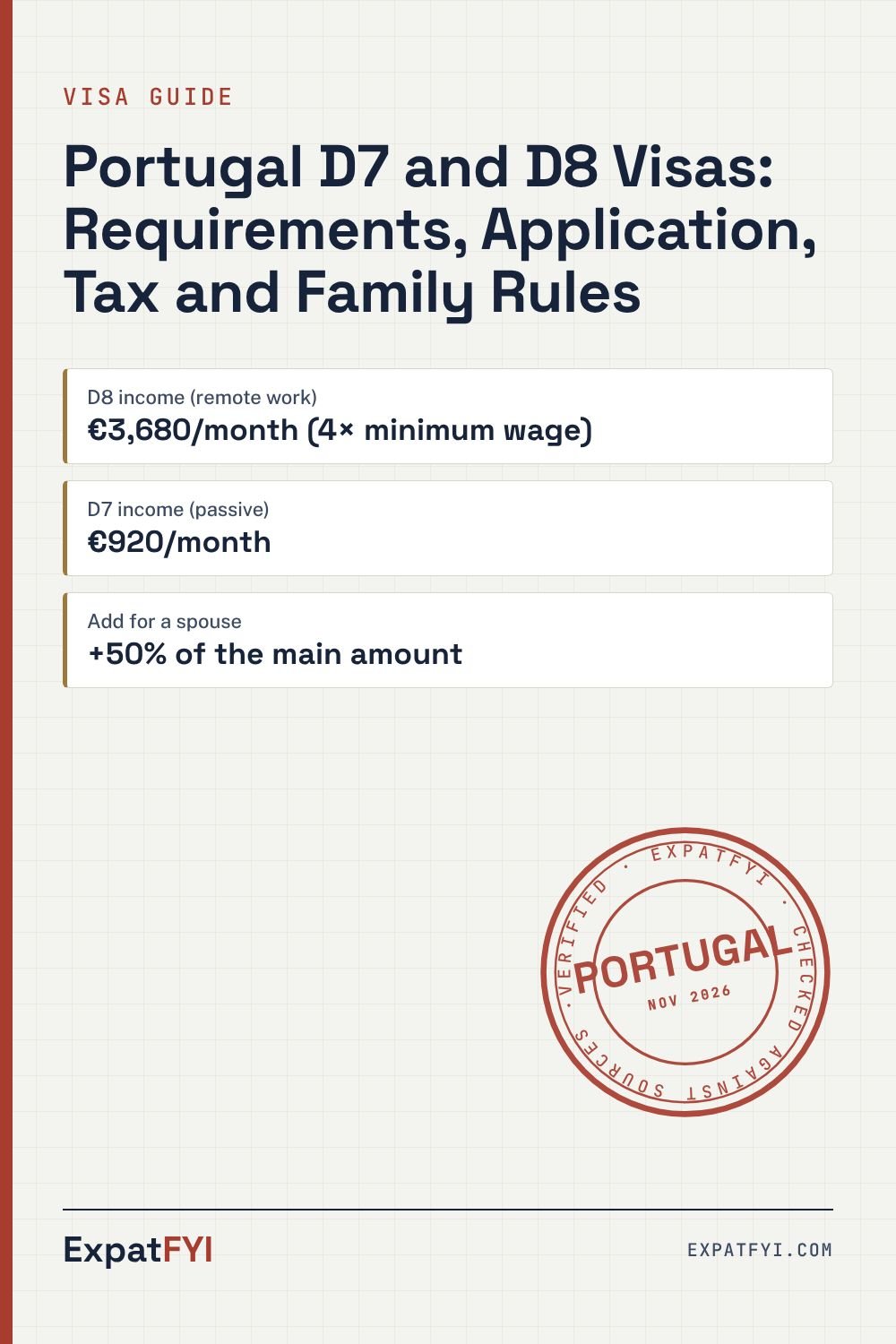
Portugal D7 and D8 at a glance
- D8 income (remote work)
- €3,680/month (4× minimum wage)
- D7 income (passive)
- €920/month
- Add for a spouse
- +50% of the main amount
- Add per child
- +30%
- First residence permit
- 2 years, then 3-year renewals
- Permanent residence
- After 5 years
Portugal D7 and D8 Visas requirements
Portugal runs two visa tracks nomads actually use: the D7, originally built for passive-income retirees but now commonly used by remote workers, and the D8, introduced specifically for digital nomads. Both lead toward residency rather than a short-term permit.
The D8 is the more direct route for remote employees and freelancers, requiring proof of a work contract or client agreements plus consistent monthly income. The D7 works better if your income comes from a mix of sources — investments, rental income, a pension, or freelance work — rather than a single employer.
Both require proof of accommodation in Portugal for the visa period, a clean criminal record certificate, and private health insurance until you're enrolled in the Portuguese system. The income threshold is indexed to Portugal's minimum wage and updates every January — as of 2026, that puts the D7 (passive income) floor at €920/month (€11,040/year) for a single applicant, and the D8 (active remote income) route needs four times the minimum wage: €3,680 a month for 2026. Both add roughly 50% for a spouse and 30% per dependent child.
- Proof of remote income (contract, invoices, or bank statements) — €920/month for the D7 (passive income) and €3,680/month for the D8 (remote work), based on the €920 minimum wage set in January 2026
- Accommodation proof — a rental agreement or property deed
- Criminal record certificate, apostilled
- Private health insurance valid in Portugal
- Proof of Portuguese tax number (NIF) — arranged before applying
How to apply for the Portugal D7 and D8 Visas
- Get a Portuguese NIF (tax number) — most applicants use a fiscal representative to arrange this remotely before traveling.
- Open a Portuguese bank account, which some consulates require before visa submission.
- Gather and apostille your documents — criminal record, proof of income, accommodation.
- Submit the visa application at the Portuguese consulate serving your home address. The D8 commonly takes 30-60 days to process; build in buffer time either side of that range, since individual consulates vary.
- On arrival, you'll typically need to attend an appointment with AIMA (Portugal's immigration agency) to convert the visa into a residence permit.
Portugal D7 and D8 Visas tax rules
Portugal's Non-Habitual Resident (NHR) regime closed to new applicants as of January 2025, replaced by a narrower incentive commonly called IFICI ("NHR 2.0"). The key difference: NHR was broadly available to retirees, passive-income earners, and remote workers; IFICI targets a much narrower list of "high-value" professional activities (research, innovation, specific tech and scientific roles), offering a 20% flat rate on qualifying income for those who fit it. Most general remote workers and freelancers won't qualify for IFICI the way they may have for NHR — don't assume older content about NHR still applies to you. If you already held NHR status before it closed, your original 10-year benefit period continues unaffected.
You generally become a Portuguese tax resident after spending more than 183 days in the country in a calendar year, or if Portugal becomes your primary residence. At that point, worldwide income typically becomes reportable in Portugal — talk to a tax professional familiar with both Portugal and your home country before you commit to a long stay.
Renewing the Portugal D7 and D8 Visas
The initial D7/D8 residence permit is issued for 2 years. The first renewal extends it to 3 years, and subsequent renewals continue on that 3-year cycle. Permanent residency becomes available after 5 years of legal residence, and citizenship after 10 (7 for CPLP nationals) under current law. As of February 2026, AIMA's online Portal de Renovações handles most renewals without an in-person appointment — a real improvement over the in-person-only process this used to require. Keep every document from your original application; renewal generally asks for updated versions of the same proof.
Bringing family with you
Both the D7 and D8 support family reunification, allowing a spouse or partner and dependent children to apply alongside or after the primary applicant. Each family member generally needs their own set of documents — criminal record, proof of relationship, and health insurance — and the income threshold scales up accordingly: roughly 50% more on top of the base requirement for a spouse, and 30% more per dependent child. On the 2026 base figures, that's real money — a couple with one child clears roughly €19,872/year against the D7's base threshold alone, before the higher D8 active-income floor is even factored in.
Quick answers
How much income do I need for Portugal's D8 digital nomad visa?
€3,680 a month in 2026, four times Portugal's €920 minimum wage. Add 50% for a spouse or partner and 30% for each child, so a family of four needs about €7,728.
What is the difference between Portugal's D7 and D8 visas?
The D8 is for remote employees and freelancers and needs €3,680 a month in work income. The D7 is for passive income such as pensions, rent or investments and needs €920 a month.
Can I still get NHR tax status in Portugal?
No. NHR closed to new applicants in 2025. Its replacement, IFICI, offers 20% on qualifying income but only for specific high-value professions, so most remote workers pay standard Portuguese rates.
Does the D8 lead to permanent residency in Portugal?
Yes. The residence permit is issued for 2 years, then renewed for 3, and after 5 years of legal residence you can apply for permanent residence.
Does your income qualify?
Check your passport and income against Portugal and every other country we cover, then see what a month costs in each city.
Check my eligibilityHealth insurance comes first
Most remote-work and residence visas ask for proof of health coverage that's valid in the country. Compare nomad insurers before you assemble your file.
Compare insuranceThis is informational, not advice. Visa, tax, and immigration rules change, and a general guide can't account for your specific situation. Before you act on anything here, confirm current details with the relevant embassy, consulate, or a licensed immigration or tax professional. See our editorial policy for how we verify what we publish.